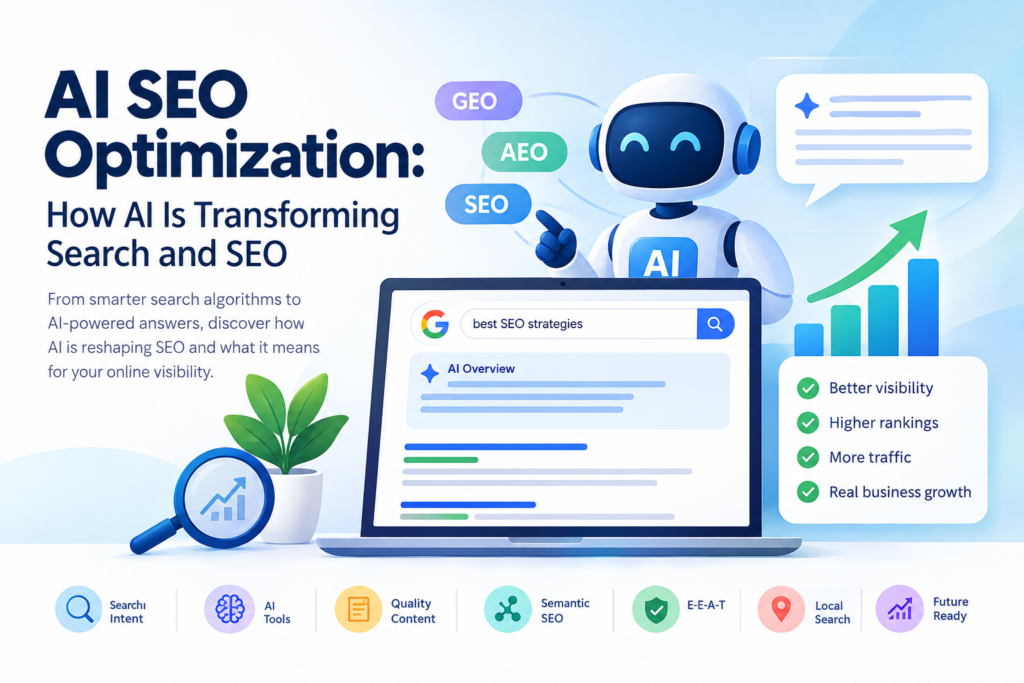
Search is changing rapidly. People are no longer relying only on traditional Google search results to find information, products, and services. They are increasingly using AI-powered search experiences and conversational platforms to research questions, compare options, discover businesses, and make purchasing decisions.
This shift is changing how businesses approach Search Engine Optimization (SEO).
Traditional SEO remains important, but ranking for a keyword is no longer the only objective. Businesses now need to create content that search engines and AI systems can understand, trust, interpret, and use when generating answers.
This is where AI SEO optimization comes into play.
AI SEO combines traditional SEO principles with artificial intelligence, semantic search, natural-language optimization, structured data, content optimization, and analysis of search intent. The goal is to improve a website’s visibility across traditional search engines as well as emerging AI-powered search experiences.
What Is AI SEO Optimization?
AI SEO optimization is the process of using artificial intelligence and modern search optimization techniques to improve a website’s visibility, relevance, and authority.
Traditional SEO often focuses on factors such as:
- Keyword targeting
- Technical SEO
- On-page optimization
- Internal linking
- Content quality
- Backlinks
- Search rankings
- User experience
AI SEO expands this approach by focusing more heavily on context, entities, user intent, conversational queries, semantic relationships, and how AI-powered search systems interpret information.
For businesses, this means the goal is no longer simply to rank for individual keywords. Content should provide clear, useful, trustworthy answers to the questions potential customers are actually asking.
How AI Is Changing Search
Search engines have become much better at understanding the meaning behind queries rather than simply matching individual words.
For example, a user searching for:
“best SEO agency”
may have a very different intent from someone searching for:
“How much does an SEO agency cost for a small business?“
or:
“What should I look for when choosing an AI SEO agency?”
These searches contain different levels of intent and require different types of content.
AI-powered search systems can analyze the context of a query, identify related concepts, and provide more conversational answers. This makes search intent, topical relevance, and content structure increasingly important.
Google and other search platforms are also introducing AI-generated search experiences that can summarize information and help users explore topics without relying exclusively on a traditional list of blue links.
As a result, businesses need to think beyond conventional rankings and consider how their brand and content can become visible within AI-assisted search journeys.
AI SEO vs. Traditional SEO
AI SEO does not replace traditional SEO. Instead, it builds on the fundamentals that already make a website accessible, useful, and trustworthy.
Traditional SEO focuses heavily on improving visibility in organic search results.
AI SEO adds additional considerations, including:
- Natural-language and conversational queries
- Search intent and context
- Entity optimization
- Semantic relationships
- Structured data
- Answer-focused content
- AI search visibility
- Brand authority and online mentions
- Content that can be easily interpreted and summarized by AI systems
The strongest strategy is therefore not to abandon traditional SEO, but to combine established SEO practices with optimization for modern AI-powered search.
8 Ways AI SEO Can Improve Search Visibility
1. Understand Search Intent
Keywords are still useful, but understanding why someone searches for a particular phrase is even more important.
A keyword such as “CRM software” could represent informational, commercial, or transactional intent.
A user searching for:
“best CRM software for a small business”
is likely looking for comparisons or recommendations.
Someone searching for:
“CRM software pricing”
may be closer to making a purchasing decision.
AI-powered analysis can help identify patterns in search queries and group them according to intent.
Businesses can then create content that directly addresses each stage of the customer journey.
2. Build Content Around Topics, Not Just Keywords
Modern search is increasingly contextual.
Instead of creating separate pages for every minor keyword variation, businesses should develop comprehensive topical coverage.
For example, an SEO agency could create content covering:
- What is SEO?
- How does SEO work?
- Technical SEO
- On-page SEO
- Local SEO
- AI SEO
- GEO
- AEO
- SEO reporting
- SEO pricing
- SEO strategy
- Measuring SEO ROI
These topics can be connected through internal links and organized into logical content clusters.
This helps users navigate the website while giving search systems clearer context about the site’s expertise.
3. Optimize Content for AI Search
AI search systems need clear and understandable information.
Content should answer important questions directly instead of forcing users to search through long paragraphs to find an answer.
Useful approaches include:
- Clear headings
- Short introductory answers
- Question-and-answer sections
- Descriptive subheadings
- Lists and tables where appropriate
- Relevant examples
- Accurate facts and supporting sources
- Clear definitions
- Logical internal linking
For example, instead of beginning an article with several paragraphs of general information, answer the primary question first and then explain the topic in greater depth.
This answer-first structure can make content easier for both users and search systems to understand.
4. Strengthen E-E-A-T and Brand Authority
AI systems need reliable information.
That makes experience, expertise, authoritativeness, and trust important components of modern SEO.
Businesses should clearly demonstrate:
- Who created the content
- Relevant professional experience
- Author credentials
- Business expertise
- Original research or data
- Reliable references
- Customer experiences and case studies
- Transparent company information
A website should also maintain consistent information about its brand, products, services, locations, and areas of expertise across relevant online platforms.
The clearer the information is, the easier it becomes for search systems to understand what a business does and who it serves.
5. Use Structured Data and Clear Website Architecture
Structured data can help search engines better understand the entities and information contained on a website.
Depending on the website, relevant schema types may include:
- Organization
- LocalBusiness
- Service
- Product
- Article
- FAQ
- Person
- Breadcrumb
- Review
Schema should accurately represent the content visible on the page. It should not be used to add misleading or unsupported information.
Website architecture also matters. Important pages should be easy to discover, logically organized, and connected through relevant internal links.
6. Use AI for SEO Analysis and Content Optimization
AI can significantly reduce the amount of time required for repetitive SEO tasks.
For example, AI-assisted workflows can help with:
- Keyword and topic research
- Search-intent analysis
- Content briefs
- Competitor analysis
- Content gap analysis
- Internal-link recommendations
- Meta title and description ideas
- Content refresh opportunities
- SERP analysis
- Reporting and data analysis
However, AI should be treated as an assistant rather than a replacement for human expertise.
AI-generated information can contain errors, outdated information, or unsupported claims. Content should therefore be reviewed, fact-checked, edited, and improved by knowledgeable people before publication.
7. Optimize for Local and Conversational Search
AI has also changed the way people ask local questions.
Instead of searching only for:
“SEO agency London”
a potential customer might ask:
“Which SEO agencies in London specialize in AI search optimization?”
or:
“Who can help my local business improve visibility in Google and AI search?”
This makes local SEO, Google Business Profile optimization, location-specific content, reviews, structured data, and consistent business information increasingly important.
Businesses should ensure that their name, address, phone number, services, locations, opening hours, and other important information are accurate and consistent across relevant platforms.
8. Measure AI Search Visibility
Traditional SEO reporting often focuses on metrics such as:
- Organic traffic
- Keyword rankings
- Click-through rate
- Backlinks
- Conversions
These metrics remain valuable, but AI search introduces additional questions.
For example:
- Is the brand appearing in AI-generated answers?
- Which questions are associated with the brand?
- Which competitors are being mentioned?
- Which topics generate AI visibility?
- Are AI search visitors reaching the website?
- Which pages are being referenced or surfaced?
- Is brand visibility improving across AI search platforms?
Businesses should therefore combine traditional SEO measurement with AI visibility monitoring to develop a more complete picture of search performance.
SEO, AEO and GEO: How They Work Together
The evolution of search has introduced several related optimization approaches.
SEO — Search Engine Optimization
SEO focuses on improving visibility in traditional search engines through technical optimization, content, links, search intent, user experience, and other ranking factors.
AEO — Answer Engine Optimization
AEO focuses on creating content that directly answers questions and is structured for answer-oriented search experiences.
GEO — Generative Engine Optimization
GEO focuses on improving the likelihood that a business, brand, service, or content source is represented accurately and prominently within generative AI search experiences.
These approaches overlap significantly.
A strong modern search strategy should therefore consider SEO, AEO, and GEO together rather than treating them as completely separate disciplines.
How to Build an AI SEO Strategy
A practical AI SEO strategy can be divided into several stages.
Step 1: Audit Your Existing Website
Start by reviewing:
- Technical SEO
- Indexability
- Website architecture
- Existing content
- Search rankings
- Internal links
- Backlink profile
- Structured data
- Page speed
- Mobile experience
- Local SEO signals
Step 2: Identify Search Intent and Content Gaps
Analyze what your target audience is searching for and compare your content with competitors.
Look for questions and topics that your competitors address but your website does not.
Step 3: Create Helpful, Answer-Focused Content
Develop content around real customer questions and problems.
Each page should have a clear purpose and provide useful information instead of simply repeating keywords.
Step 4: Improve Entity and Semantic Relevance
Make it clear:
- Who your company is
- What services you provide
- Where you operate
- Who you serve
- What industries you specialize in
- What makes your expertise relevant
Connect related topics through logical internal linking and consistent terminology.
Step 5: Strengthen Authority
Build authority through high-quality content, legitimate digital PR, relevant backlinks, expert contributions, original research, reviews, and credible online mentions.
Avoid manipulative link-building practices that can create long-term risks.
Step 6: Monitor Traditional and AI Search
Track both traditional SEO performance and AI search visibility.
This allows you to identify where your website is gaining visibility and where additional optimization may be required.
Common AI SEO Mistakes to Avoid
AI SEO can create significant opportunities, but businesses should avoid several common mistakes.
Publishing Large Volumes of Unedited AI Content
Generating hundreds of articles does not automatically create search visibility.
Content still needs expertise, originality, accuracy, useful information, and a clear purpose.
Focusing Only on Keywords
Keyword optimization without understanding search intent can result in content that matches a phrase but fails to answer the user’s actual question.
Ignoring Technical SEO
AI SEO does not eliminate the need for a technically sound website.
Search engines still need to crawl, understand, and index your content effectively.
Using Unsupported Claims
AI-generated content can sometimes produce inaccurate statistics, references, or statements.
Always verify important information before publishing.
Treating AI Search as a Separate Channel
AI search should be considered part of a broader search strategy.
The same fundamentals—useful content, authority, technical accessibility, relevance, and trust—remain important.
The Future of AI SEO
Search will continue to evolve as artificial intelligence becomes more deeply integrated into search engines and digital experiences.
Users are likely to interact with search in increasingly conversational ways, asking complex questions rather than entering short keyword phrases.
For businesses, this means SEO strategies will need to become more focused on:
- Search intent
- Conversational queries
- Topical authority
- Brand entities
- First-hand expertise
- Structured information
- Helpful content
- AI search visibility
- Local and personalized search
- Continuous measurement and optimization
The future of SEO is therefore not simply about ranking for more keywords.
It is about becoming a trusted and useful source of information wherever customers search.
Final Takeaway
AI is changing how people discover information, compare businesses, and make decisions online. Traditional SEO remains an essential foundation, but businesses now need to consider how their content can be understood across both conventional search engines and AI-powered search experiences.
AI SEO optimization brings together technical SEO, content strategy, search intent, semantic optimization, structured data, authority building, AEO, and GEO to create a broader approach to search visibility.
The businesses that adapt their SEO strategies around users, useful information, expertise, and emerging search experiences will be better positioned to remain visible as the search landscape continues to evolve.
If your website is not appearing where your potential customers are searching, an AI SEO audit can help identify technical, content, entity, and visibility opportunities and create a practical roadmap for improvement.