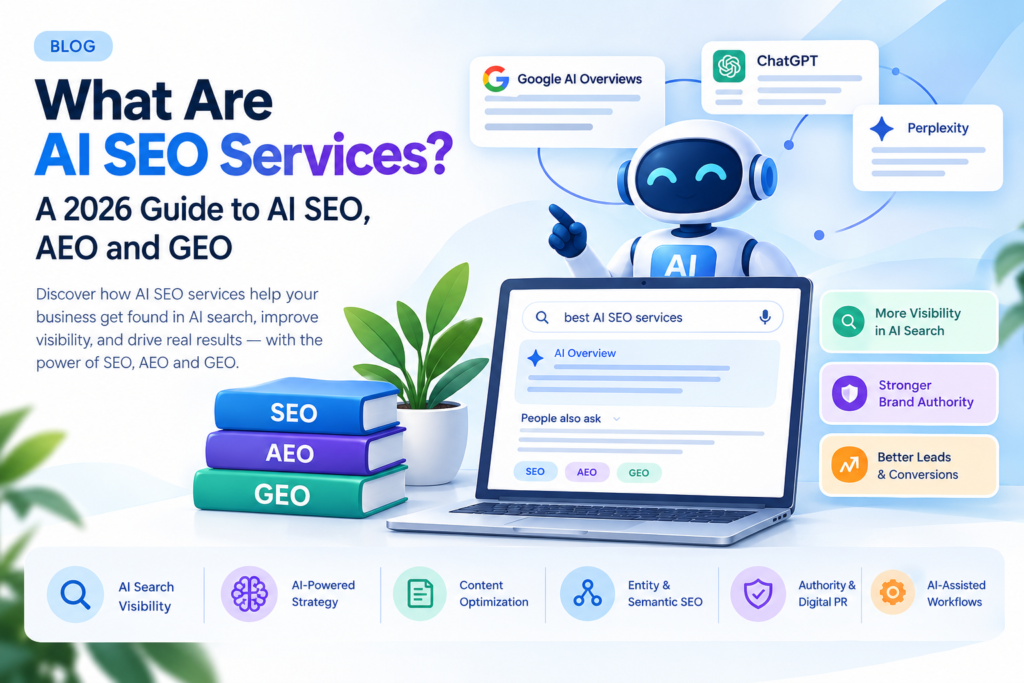
Search is changing. People are no longer relying only on traditional Google search results to discover businesses, services, products, and information. AI-powered search experiences such as Google AI Overviews, ChatGPT, and Perplexity are becoming an increasingly important part of how people research and make decisions online.
This shift has created a new opportunity for businesses: AI SEO.
AI SEO services combine traditional Search Engine Optimization (SEO) with strategies designed to improve visibility across AI-powered search and answer engines. The goal is not simply to rank a webpage for a keyword, but to help your brand become a trusted, relevant source that AI systems can understand, reference, and cite.
What Are AI SEO Services?
AI SEO services focus on two closely connected areas.
First, they help businesses improve their visibility in AI-powered search experiences, including Google AI Overviews, ChatGPT, Perplexity, and other generative search platforms.
Second, they use AI tools to make traditional SEO processes more efficient, including research, competitor analysis, content planning, technical analysis, and performance monitoring.
The first area overlaps significantly with:
- Answer Engine Optimization (AEO)
- Generative Engine Optimization (GEO)
- Entity and semantic SEO
- AI search visibility
- Brand authority and online mentions
The second area focuses on using AI as an assistant to improve the speed and efficiency of SEO work.
A professional AI SEO strategy combines both. AI should support SEO strategy and execution, not replace human expertise, research, experience, or editorial judgement.
How Is AI SEO Different From Traditional SEO?
Traditional SEO is primarily focused on improving a website’s visibility in organic search results.
AI SEO extends this approach to include visibility within AI-generated answers and conversational search experiences.
For example, traditional SEO may focus on ranking a page for:
“AI SEO agency”
AI SEO and AEO strategies may also consider questions such as:
“Which AI SEO agency can help my business appear in ChatGPT and Google AI Overviews?”
This means businesses need to think beyond individual keywords and focus on the broader context behind customer questions.
AI SEO places greater emphasis on:
- Search intent
- Natural-language queries
- Clear and factual answers
- Topical authority
- Structured content
- Structured data and schema
- Entity understanding
- Brand authority
- Online mentions
- Relevant backlinks
- Consistent business information
- AI search visibility
AI SEO does not replace traditional SEO. Instead, it adds another layer to an effective SEO strategy.
What Is the Difference Between SEO, AEO and GEO?
AI SEO, AEO, and GEO are closely related, but they have slightly different focuses.
SEO – Search Engine Optimization
SEO focuses on improving visibility in traditional search engines through technical SEO, content, links, search intent, user experience, and website authority.
AEO – Answer Engine Optimization
AEO focuses on creating content that directly answers user questions in a clear, structured, and useful format.
The objective is to make information easier for answer engines and search systems to understand and potentially surface when users ask questions.
GEO – Generative Engine Optimization
GEO focuses on improving a brand’s visibility and representation within generative AI search experiences.
This includes helping AI systems understand:
- Who your business is
- What you offer
- Where you operate
- Who you serve
- What topics you have expertise in
- Why your business is relevant to a particular query
Together, SEO, AEO, and GEO create a broader search visibility strategy for the modern search landscape.
What Is Included in AI SEO Services?
A comprehensive AI SEO service can include several areas of optimization.
1. AI Search Visibility Audit
The first step is understanding how your business currently appears across search engines and AI platforms.
An AI visibility audit can examine:
- Brand mentions
- AI-generated answers
- Search visibility
- Competitor visibility
- Frequently asked questions
- Content gaps
- Citation opportunities
- Relevant online sources
- Existing authority signals
The objective is to establish a baseline and identify opportunities for improvement.
2. Search Intent and Content Research
AI SEO starts with understanding what your target audience is actually asking.
Instead of focusing only on high-volume keywords, research should identify the questions, problems, comparisons, and buying decisions that matter to your customers.
For example, instead of targeting only:
“SEO services”
a business could create content around questions such as:
- What do SEO services include?
- How much do SEO services cost?
- How does AI SEO work?
- What is the difference between SEO and GEO?
- How can a business appear in Google AI Overviews?
- How can I improve my visibility in ChatGPT?
This approach creates content that addresses real search intent.
3. Answer-Focused Content
AI search relies heavily on understanding information and providing direct answers.
Your content should therefore be easy to understand and logically structured.
Effective answer-focused content can include:
- Clear headings
- Direct answers
- Short introductory explanations
- FAQs
- Lists
- Tables
- Step-by-step explanations
- Supporting examples
- Relevant statistics and evidence
- Clear conclusions
The objective is not to write content specifically for machines. It is to create genuinely useful content that is easy for both people and search systems to understand.
4. Structured Data and Schema
Structured data helps search engines better understand the information presented on a webpage.
Depending on the website, relevant schema can include:
- Organization
- LocalBusiness
- Service
- Product
- Article
- FAQ
- Person
- Breadcrumb
- Review
Schema should accurately reflect the information visible on the page. It should support search-engine understanding rather than be used to manipulate search results.
5. Entity and Semantic SEO
AI-powered search needs to understand relationships between businesses, people, products, services, locations, and topics.
Entity SEO helps create a clearer digital identity for your business.
For example, a business should consistently communicate:
- Business name
- Services
- Locations
- Industries served
- Areas of expertise
- Team expertise
- Products
- Relevant categories
Related content should also be connected through logical internal linking and consistent terminology.
This creates stronger semantic relationships across the website.
6. Authority and Brand Mentions
Visibility in AI search is not only about what you publish on your own website.
Your business can also benefit from relevant mentions and references across the wider web.
AI SEO strategies may therefore include:
- Digital PR
- Relevant backlinks
- Industry publications
- Expert contributions
- Business directories
- Reviews
- Case studies
- Partner websites
- Industry-specific mentions
The focus should be on earning relevant, trustworthy authority rather than generating large quantities of low-quality links.
7. AI-Assisted SEO Workflows
AI can also help SEO professionals work more efficiently.
AI-assisted workflows can support:
- Keyword research
- Search-intent analysis
- Competitor research
- Content briefs
- Content gap analysis
- Topic clustering
- Internal-link recommendations
- Content refreshing
- Meta title and description ideas
- SEO reporting
- Data analysis
However, AI-generated recommendations should be reviewed by an experienced SEO professional.
AI can make mistakes, misunderstand context, or provide outdated information. Human expertise remains essential for strategy, fact-checking, brand positioning, and final content quality.
Do You Still Need Traditional SEO?
Yes.
AI SEO does not eliminate traditional SEO fundamentals.
AI-powered search still relies on information that can be discovered, understood, and evaluated. A website should therefore have a strong technical and content foundation.
Important fundamentals include:
- Crawlability
- Indexability
- Website architecture
- Page speed
- Mobile usability
- Internal linking
- Relevant content
- Search intent
- Technical SEO
- Structured data
- Website authority
- Trust signals
Think of AI SEO as an additional layer built on top of strong SEO foundations.
A technically weak website with poor content is unlikely to become successful simply because AI tools or GEO tactics are added.
Why Is AEO Important for AI Search?
People increasingly ask complete questions rather than searching with short keyword phrases.
For example:
“Best digital marketing agency”
could become:
“What should I look for when choosing a digital marketing agency for a SaaS company?”
AEO helps businesses prepare content for these conversational and question-based searches.
A strong AEO strategy focuses on answering important customer questions clearly and comprehensively.
Useful AEO content formats include:
- FAQ pages
- Question-based blog posts
- How-to guides
- Comparison pages
- Definitions
- Step-by-step guides
- Service FAQs
- Product questions
- Expert explanations
The more effectively your website answers relevant questions, the more useful it becomes within modern search experiences.
How Does GEO Help Businesses?
Generative Engine Optimization focuses on visibility within generative AI systems.
Instead of only asking:
“How do I rank this page?”
GEO encourages businesses to consider questions such as:
“Does AI understand my brand?”
“Is my business associated with the right services and topics?”
“Are credible websites mentioning my business?”
“Does my content clearly demonstrate expertise?”
“Are competitors appearing in AI-generated answers while my brand is missing?”
GEO therefore combines content quality, entity clarity, authority, relevance, and broader digital presence.
How Much Do AI SEO Services Cost?
AI SEO pricing varies depending on the size of the website, level of competition, target market, technical requirements, content requirements, and scope of the campaign.
Some businesses may start with an AI SEO audit and strategy, while others may require ongoing SEO, AEO, and GEO optimization.
Before choosing a provider, look beyond the monthly price.
Consider what is actually included:
- AI visibility auditing
- SEO audit and technical improvements
- Content strategy
- AEO optimization
- GEO strategy
- Schema implementation
- Entity optimization
- Digital PR and authority building
- Competitor analysis
- AI visibility monitoring
- Reporting
- Ongoing optimization
The right investment should be connected to measurable improvements in search visibility, qualified traffic, brand visibility, and business enquiries.
How Do You Choose an AI SEO and AEO Agency?
The AI SEO industry is developing quickly, so businesses should look for a provider that combines practical SEO experience with a clear understanding of AI search.
Before hiring an agency, ask:
Do they have a clear AI SEO methodology?
A professional agency should be able to explain what it will analyze, optimize, measure, and improve.
Do they understand traditional SEO?
AI SEO should be built on strong technical, content, and authority foundations.
Can they measure AI visibility?
Ask how the agency tracks visibility across relevant AI search platforms and how it reports progress.
Do they focus on real content quality?
Be cautious of agencies that promise large volumes of automatically generated content without meaningful strategy, editing, or fact-checking.
Do they provide transparent reporting?
You should understand what work is being completed and how performance is being measured.
Do they avoid unrealistic guarantees?
AI search is constantly evolving. No agency can legitimately guarantee a specific AI-generated answer, citation, or ranking position.
Common AI SEO Mistakes to Avoid
Businesses should avoid several common mistakes when implementing AI SEO.
Treating AI SEO as a shortcut
AI SEO is not a replacement for good SEO.
Publishing unedited AI-generated content
AI can accelerate content production, but content still requires human review, expertise, originality, and fact-checking.
Focusing only on keywords
Search intent and topical relevance are increasingly important.
Ignoring technical SEO
AI optimization cannot compensate for major crawlability, indexability, performance, or architecture problems.
Creating low-quality backlinks
Authority should be built through relevant and trustworthy sources rather than manipulative link schemes.
Promising guaranteed AI rankings
AI-generated search experiences are dynamic. A credible agency should focus on improving visibility and relevance rather than guaranteeing a specific outcome.
How to Build an AI SEO Strategy in 2026
A practical AI SEO strategy can follow these steps:
Step 1: Audit your website
Review technical SEO, content, website architecture, internal links, schema, authority, and existing search visibility.
Step 2: Analyze your competitors
Identify which competitors appear for important search queries and how they structure their content and authority signals.
Step 3: Research customer questions
Find the questions your target customers ask before, during, and after making a purchasing decision.
Step 4: Build topical authority
Create comprehensive content around the subjects your business is qualified to discuss.
Step 5: Optimize for answers
Structure important content around clear questions, direct answers, supporting information, and useful examples.
Step 6: Strengthen entities and authority
Make your business identity, expertise, services, locations, and relevant relationships clear across your website and the wider web.
Step 7: Improve technical SEO and structured data
Ensure search engines and AI systems can efficiently access and understand your website.
Step 8: Monitor AI and traditional search visibility
Track organic rankings, traffic, conversions, brand mentions, AI visibility, and relevant citation opportunities.
Step 9: Continuously improve
AI search is evolving. Your strategy should evolve with it.
The Future of AI SEO, AEO and GEO
The future of search is moving toward more conversational, contextual, and AI-assisted experiences.
Users can increasingly ask complex questions and expect a direct answer rather than simply receiving a list of webpages.
For businesses, this creates a broader definition of search visibility.
Success is no longer only about ranking a page for a keyword.
It is also about becoming a trusted source that search engines and AI systems can understand, associate with relevant topics, and potentially reference when answering customer questions.
This makes the combination of SEO, AEO, and GEO increasingly important.
Final Takeaway
AI SEO services are not about replacing traditional SEO with artificial intelligence.
They are about extending SEO into a changing search environment.
A strong AI SEO strategy combines:
- Traditional SEO
- AI search optimization
- AEO
- GEO
- Search-intent research
- Helpful content
- Entity optimization
- Structured data
- Brand authority
- Digital PR
- AI-assisted SEO workflows
- Continuous measurement
The businesses that focus on useful information, genuine expertise, technical quality, and strong digital authority can build a stronger foundation for visibility across both traditional and AI-powered search.
If you want to understand how your website currently performs across Google and AI search platforms, an AI SEO and AEO audit can identify visibility gaps, content opportunities, technical issues, and practical next steps for improving your search presence.
#AISEO #AISEOServices #